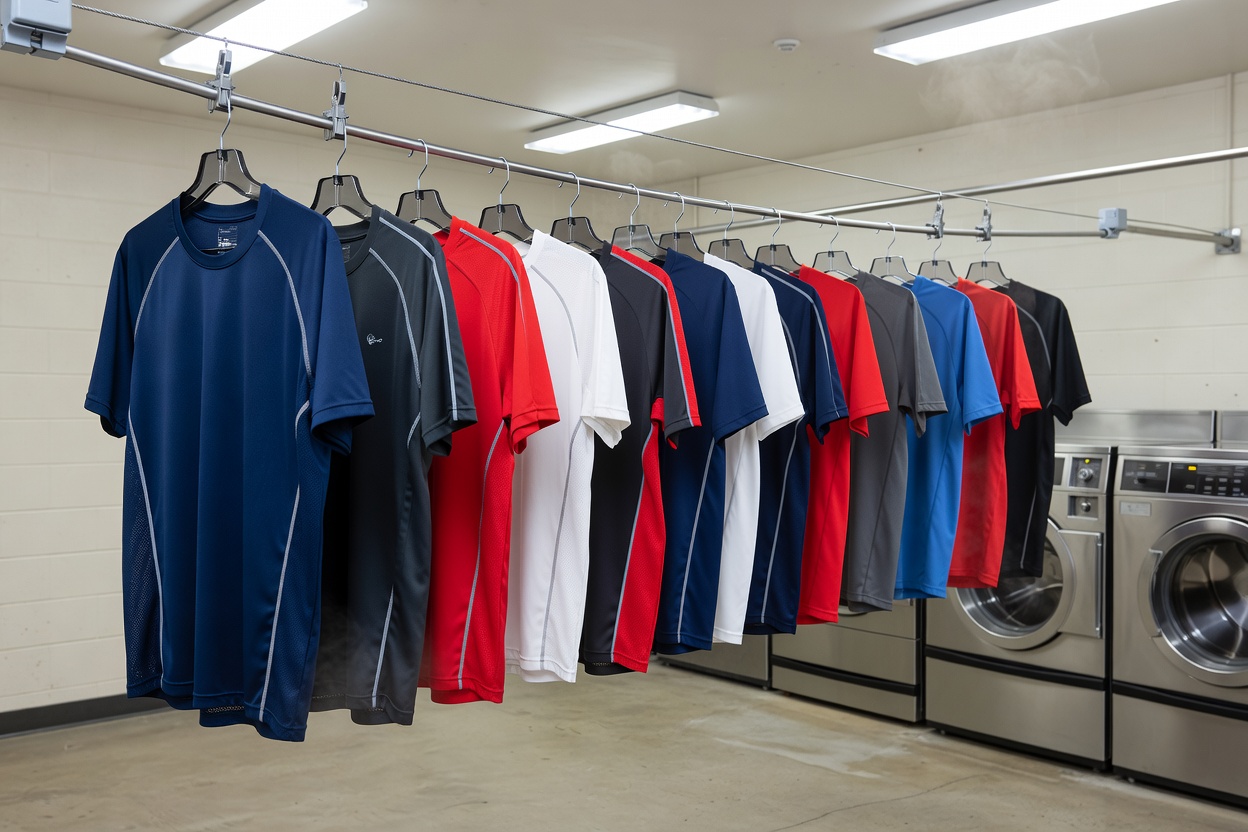
The Science of Sports Kit Textiles
Match garments and training apparel are not simple woven cloths. Modern jerseys, shorts, base layers, and crew socks incorporate hydrophobic synthetic yarns, elastomeric core bands, and silicone grip laminates. When washed with harsh chemicals or dried under uncontrolled heat, these high-spec polymers degrade quickly.
Our washing and drying operations follow care-label guidance reinforced by empirical textile standards. We configure detergent pH, surfactant foam profiles, drum rotation cycles, and de-humidification rates according to garment composition.
Garment Categories Handled in Kit Cycles
A single club kit bag contains wildly diverse textiles. We split items into dedicated sub-loads before washing:
- Match Jerseys & Shorts: Lightweight polyester micro-mesh with heat-bonded silicone crests, rubberized numbers, and sponsor transfers. Must not contact zippers or rough Velcro.
- Compression Base Layers: High elastane and nylon blends. Highly sensitive to heat stress. Retain body odors if not processed with specialized low-temp enzymatic surfactant formulas.
- Match & Training Socks: Dense nylon, cotton, and spandex composites with padded terry soles. Carry high ground soil, perspiration salts, and turf particles. Require deeper soil flush phases.
- Warm-Up Tops & Sideline Jackets: Water-repellent finishes, mesh linings, and metallic zip hardware. Cleaned inside-out with sealed zippers to prevent surface scratching.
- Physiotherapy & Team Towels: High-pile cotton terry requiring isolated wash cycles to prevent lint transfer onto synthetic jerseys.
Temperature Controls and Surfactant Chemistry
High temperatures break down synthetic polymer bonds. Thermal exposure above 45°C causes micro-cracking in polyurethane jersey prints and leads to adhesive migration, where lettering edges turn sticky and collect lint.
We run all synthetic kit cycles between 30°C and 40°C. To compensate for reduced thermal action, we utilize liquid multi-enzyme detergents that target organic soils at lower temperatures. Amylase digests carbohydrate-based sports nutrition smears, protease breaks down blood and sweat proteins, and lipase breaks down body oils without attacking base fibers.
Strict Fabric Handling Rules
- No Fabric Conditioners: Softening agents coat fibers with a waxy cationic film. This clogs capillary moisture channels and locks anaerobic bacteria inside synthetic yarns.
- Zero Chlorine Compounds: Bleach destroys elastomeric cores, turning stretch fabric brittle and transparent.
- Controlled Spin Speeds: G-force extraction ramps smoothly to avoid press-setting wrinkles into warm polyester fibers.
De-Moisturization and Airflow Drying
Traditional high-temperature tumble dryers shrink polyester blends and melt heat transfers. Our drying facility uses controlled warm airflow chambers and computerized moisture-sensing tumblers.
Sensors measure the exhaust air temperature and humidity ratio in real time. As garments dry, evaporative cooling slows. The drying system detects this thermal shift immediately and automatically drops air intake temperature, transitioning into a cool-down tumble phase before unload. This eliminates residual static and protects player names and kit numerals from heat blistering.
Garment Integrity and Wear Management
Athletic kit faces immense friction during competition. Grass abrasions, slide tackles, and wash cycles create micro-wear. While laundering cannot repair pre-existing mechanical tears, our low-friction wash chemistry ensures washing does not accelerate wear.
Each garment is inspected as it comes off the dry line. We inspect collar neckbands, sleeve seams, waistbands, and emblem perimeters. Any structural fatigue or stitching rupture is recorded and separated for client notification.
Target Applications
- Competitive squad matchday playing kits.
- Player-specific compression garments and thermal layers.
- High-friction training jerseys subject to daily use.
- Sublimated and heat-pressed performance gear.
Operational Boundaries
- Fabric elasticity cannot be restored once heat-damaged in prior facilities.
- Certain pitch chemicals (e.g. artificial turf rubber infill residue) require multiple gentle wash cycles.
- Extreme mud encrustation must undergo gross manual de-crusting before intake.