The Logistics Challenge in Sports Textile Management
In elite and semi-professional athletic organizations, laundry problems are rarely just about cleanliness. The breakdown almost always happens in the sorting. Missing match shorts, mixed training bibs, mismatched player numbers, or kit bags arriving incomplete cause immediate locker room disruption before competition.
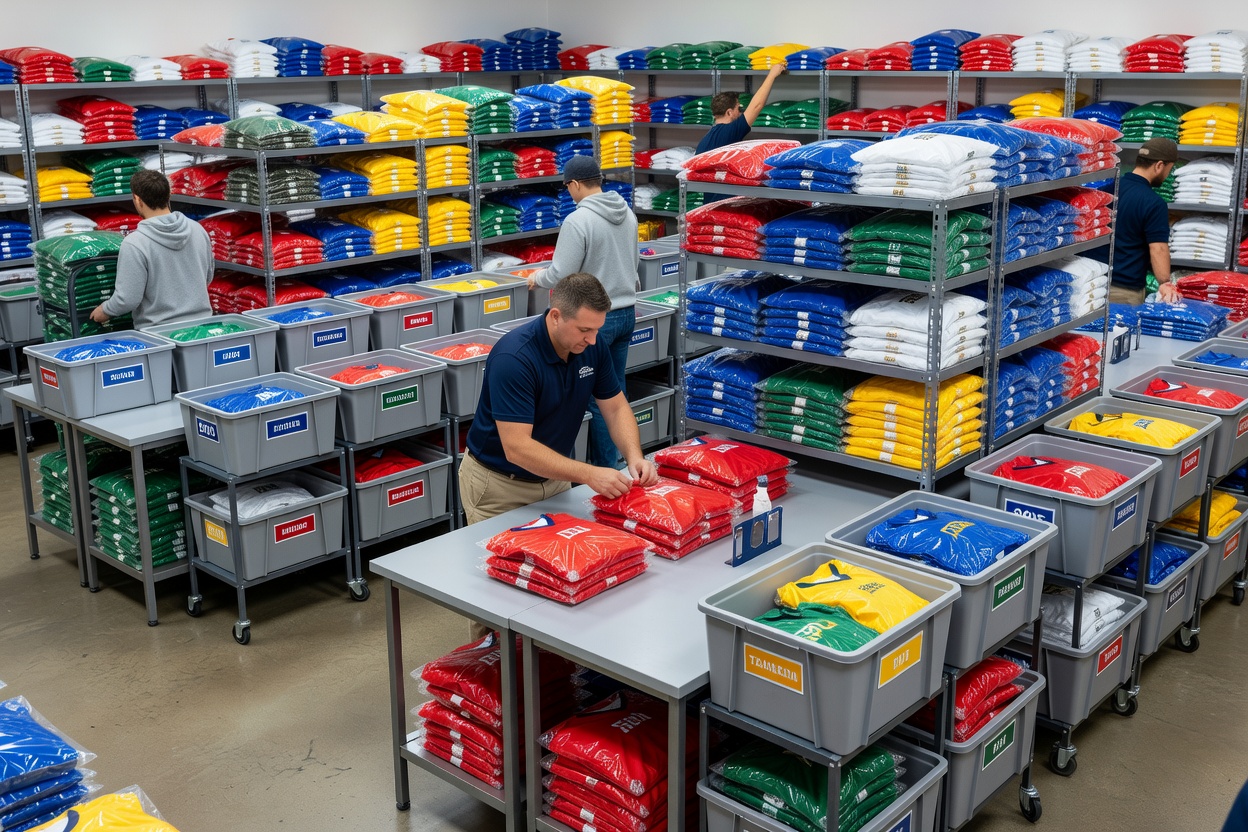
Our textile sorting and kit management service operates like a localized warehouse logistics system. Every item that enters our facility is processed according to client roster sheets, tag references, and squad numbering schemes.
Multi-Stage Sorting Architecture
Sorting is split into two distinct physical phases: Intake Disaggregation and Outtake Reconstitution.
Intake Disaggregation: Garments arrive in club kit bags or tubs. Intake operators empty bags onto clean sorting tables. Items are counted against manifest sheets. Socks are separated into matching pairs; shorts, tops, and base layers are grouped by textile classification to allow proper wash drum staging. Discrepancies (such as a missing match shirt or unmatched sock) are flagged on the intake sheet immediately.
Outtake Reconstitution: Once items complete drying and conditioning, they enter the sorting mezzanine. Here, garments are recombined using one of three structural distribution models chosen by the club equipment manager:
- Player Locker Bundles: Garments are assembled by squad number. Player 9's match jersey, shorts, compression undershorts, and socks are folded together and placed into an individual labeled breathable bag ready for their locker.
- Itemized Category Stacks: All match jerseys stacked by ascending squad number, all match shorts stacked by size (S, M, L, XL), and all socks banded by pair. This is preferred for staff kit managers traveling to away fixtures.
- Departmental Splits: First team, development squad, and coaching staff apparel returned in separate color-coded transit tubs.
Tracking and Discrepancy Prevention
We do not invent proprietary microchip tracking claims. We rely on rigorous physical verification:
- Visual Heat-Press Matching: Numbers, initials, and laundry collar tags are visually verified against the roster intake sheet at both intake and outtake.
- Pair Verification: Socks are systematically inspected for matching sizes, elastic wear, and left/right anatomical shapes before bundling.
- Discrepancy Manifests: Any item missing from an intake batch or damaged prior to washing is itemized in a digital handover summary sent to the kit manager.
Labeling and Identification Systems
Smooth kit sorting depends on clear garment markings. We work with standard team labeling systems, including:
- Standard heat-pressed match numbering.
- Internal collar/waistband embroidered initials.
- Thermal laundry barcode/alphanumeric tags attached to care labels.
- Temporary color-coded wash-safe loop rings for multi-squad tournaments.
If garments arrive unlabelled, our team flags them for generic sizing sorting and informs the club coordinator to assign permanent markers for future cycles.
Return Packaging and Transit Organization
After sorting is finalized, kit groups are prepared for transport. Garments are packed into sealed water-resistant transport bags or loaded onto hanging team garment racks protected by dust covers. Transport tubs are wiped down with food-grade sanitizing mist before clean kit repacking, ensuring external vehicle grit never transfers back onto pristine kits.
Operational Strengths
- Drastic reduction in locker room missing-kit disputes.
- Clear accountability logs from intake manifest to return bill.
- Customizable return packing (player bundles or size stacks).
- Eliminates kit manager hours spent re-sorting laundry post-wash.
Prerequisites & Notes
- Accurate squad rosters and numbering manifests must be provided prior to handoff.
- Unnumbered generic training gear cannot be sorted to individual players without tags.
- Damaged or torn labels require re-marking by team staff.